
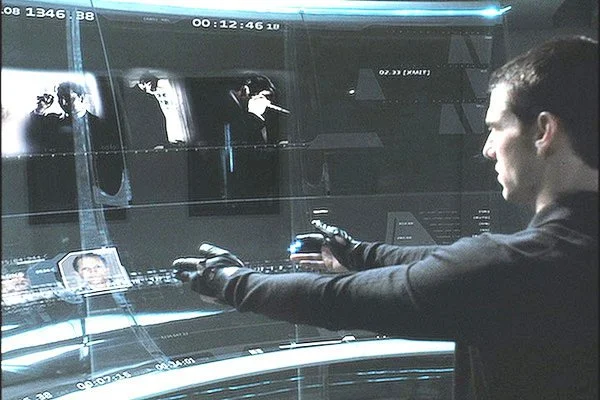
The more we become connected, the more any sense of personal privacy completely evaporates. So goes Steven Spielberg’s vision for our near future, couched in tech noir, mostly because the veil of safety and security has for decades become irrevocably ripped from society. What we see (and everything we don’t) becomes the stuff of life and death in this shadowed thriller based on (another!) Philip K. Dick story, about a pre-crime cop John Anderton (Tom Cruise) whose loyalty and dedication to his job can’t save him from bureaucratic forces. The film's central theme is the question of free will versus determinism. It examines whether free will can exist if the future is set and known in advance. Other themes include the role of preventive government in protecting its citizenry, the role of media in a future state where technological advancements make its presence nearly boundless, the potential legality of an infallible prosecutor, and Spielberg's perennial theme of broken families. There were plenty of breathtaking action set pieces— with the metallic tracking spiders ticking and swarming across a decrepit apartment floor to find Anderton submerged in an ice-cold bathtub with his eyes recently switched out via black market surgery as a key one. What impressed us when watching the movie was how much the technology in the 2002 movie foreshadowed what will happen. Like the pinch and zoom visual user interface Anderton was using to identify suspects, electronic tracking of individuals for marketing (or governmental purposes) and even the Lexus electric car. Most impressive is Spielberg’s sophistication, unafraid of the bleak tidings his film prophecies even as it feigns a storybook ending. What were your reactions to the movie?
Leadership in movies ... Apollo 13
Few movies depict crisis leadership as effectively as Apollo 13, Ron Howard's movie of the real-life NASA mission. While the workplace in question may be thousands of miles above the surface of the earth – and the crisis more pressing than most – it emphasizes the need for leaders to work together to find a positive resolution to a difficult problem. The film has particular value for larger businesses, where collaboration between individual departments can be vital for wider success and extols the idea that there is more than one way to lead successfully. In Apollo 13, this refers to the relationship between Tom Hanks' Jim Lovell, the onboard astronaut (literally) putting out fires, Ed Harris' NASA flight administrator, and Gene Kranz, orchestrating the recovery operation from Houston. Throughout, each character leads their individual team effectively, but it is the openness and the democracy of their collaboration that ultimately saves the day. Here’s a demonstration of leadership who will not submit to defeat even when it’s staring at it in the face – and who won’t let his team accept defeat either. That steely attitude will instil belief in everyone around. This show is great in highlighting crisis management, setting expectations, determination, enabling others to act, teamwork and creativity.

Creativity through watching ... Total Recall (1990)
Very loosely based on Philip K. Dick short story “We Can Remember It for You Wholesale”, Total Recall functions as a construct for Paul Verhoeven to take a high-concept premise about memory implants and lost identity and motivational uncertainty and turn it into an Arnold Schwarzenegger schlock-fest. It should be bad, but it’s not. Unlike many of it’s sci-fi action peers, Total Recall never runs out of steam or ideas; it starts with memory implant, then moves to a vividly imagined Mars society with an oppressed mutant population then gives us a secret alien reactor that’s a MacGuffin but also a deus ex machina. The plot’s a mess but so is Arnold. It all works. Verhoeven, in fact, uses Arnold to tell this darkly exuberant story, from the contorted confusion of the set-up right on through to the eye-popping finale. For as many times as Dick has been adapted, this is perhaps where the frenetic energy and imagination of his work made it work so well (Bladerunner is another thing completely!). From a thinking perspective, it was such an engrossing story but importantly made us think about what is real or are we imaging things, which has some similarities with the Matrix storyline. Although the 2012 remake was very polished and had better action sequences, the 1990 version is classic with maximum Ahh-nuld. What about your thoughts after watching this? How did you see things differently?

Total Recall 1990
Creativity through watching shows
Creativity can be stimulated through movies and television - any show that is thought provoking and expands your mind will do it! So what shows have made such a profound switch in your minds that your behaviour and worldview changes? Here are some of our favourites that we will be sharing this week and why each of them is so special.
The Matrix
A movie that is very much talked about today due to the recent release of the forth movie, The Matrix Resurrections, the original Matrix opened in 1999 and was considered one of the best sci-fi shows around. It was a time when computer-generated imagery was revolutionizing special effects, video tapes were giving way to DVDs and mobile phones were fast becoming a must-have. The Matrix captured all that. It's a movie everyone remembers -- even if they haven't seen it. Having the coolest action sequences that have never been captured on film, it had jaw dropping visuals that will not look out of place even if you watch it today. The movie brought many new ideas into our vernacular including bullet time, virtual realities, simulation theories and red/blue pill choices. Owing to its success, many similar movies about simulations and virtual reality started coming out from Hollywood which were also good (for example Cameron Crowe’s 2001 thriller “Vanilla Sky” with Tom Cruise to Christopher Nolan’s 2010 classic “Inception” to Steven Spielberg’s 2018 adaptation of Ernest Cline’s novel “Ready Player One,” about a near-future in which people leave the trash-filled Earth behind by going into a virtual gaming world) but the Matrix came first and really changed how we perceive technology and humanity.
The matrix has you …
Creativity with Board Games
Of course some of the best tools to inspire and develop a strong sense of creativity is through playing games. At ThinkLab, we have gone through hundreds of playtests and used tens of games to identify some truly useful games that work for our sessions. We do not use educational or learning-type games as their design and development is not based on our strict requirement – which is it must be fun. We sometimes use a word game to stimulate creativity like the ever popular Codenames or we might use an illustrative game like Dixit or the underappreciated Imagine. When using these games, specific words or illustrations can be swopped for gameplay that are meaningful to a company to help make a stronger link with the organization depending on your learning goal.
Many games can be used as long as the person playing the game is able to think differently and open their minds to a new approach so get a great facilitator, keep playing games and constantly try new things to increase creativity at work!

A Codenames session, Dixit cards, Imagine game
Creativity with Legos
Many of us have grown up playing with Legos but probably stop once we hit adulthood. Some may still play with their kids but we want to let you in on a little secret - playing with Legos is a wonderful creativity tool!
We use Legos in many programs and it is a highly versatile tool that can be used not only for creativity, but strategy and communication programs as well. Some may have heard of Lego Serious Play which is a wonderful facilitation method of using the Lego bricks to enhance innovation and business performance.
At ThinkLab, we use our own methodology when utilizing Legos to inspire and foster creativity during our sessions and help our clients make a breakthrough in their thought processes. Try it! Pick up the bricks and see how a couple of minutes or hours with the bricks can help alleviate ideas when stuck in a rut!

Creativity with Minecraft
Another great tool to help improve creativity is Minecraft. Adults will get as much fun and stimulation as children when they play this sandbox game. A sandbox game is where there are no set rules on how a game should be played or a specific set of winning conditions (e.g. most money, greatest area conquered or last man standing). You can be a peaceful farmer or try to fight as many mobs as possible or even end your game by killing the Ender dragon - the choice is yours. With new versions coming out, you will be able to experience and explore this amazing world anew and even learn a thing or two - definitely a great way to boost your innovative juices!
#minecraft #creativity #sandbox #experientiallearning #training #learningisfun

Welcome 2022 - let's be more creative!
Welcome all to 2022! Let’s start afresh with more content for this year and we want to start off with our most popular topic here at ThinkLab – Creativity.
It’s almost impossible to “teach” creativity as it’s about how one thinks, so what we do is to provide activities and games that will lead your neural pathways to connect differently – rewire your thoughts and behaviours. You can try some of these creativity-enhancing activities at home too – attempt more lateral quizzes and puzzles, build a complex Lego structure with your non-dominant hand or simply read a book and understand it by imagining you are someone else (as your parent? Or your child?) to see from a different perspective.
Try something different this year and see how your creativity can improve!

Wishing all a wonderful and safe 2022!

Learning from ... Marvel TV series
As Marvel continues to be in our zeitgeist and has some of the most popular escapist content, they have now moved from the silver screens to our television screens with 5 great shows. Interesting, many of these shows have surprising twists with a secret villain - whether it was Sharon Carter, “He Who Remains”, Kingpin or Agatha Harkness – although we can consider Wanda Maximoff a villain owing to what she did in Westview in VandaVision.
Narratively, we find the “What If?” show most compelling as the animated series re-worked stories we were familiar with and reinvented them without having to follow any particular arcs from the Marvel cinematic universe. Creating realistic and relatable characters in these shows also mean that the big bad is not outright evil or power hungry but more of an antihero, a victim to their flawed beliefs. Even though we are suffering a bit of superhero fatigue right now, we are still immensely enjoying the stories and characters the MCU is churning out. Here’s looking towards more great content in 2022!

Learning from ... Wheel of Time
Robert Jordan’s best-selling series of novels, The Wheel of Time is an expansive entry into the fantasy TV genre. While many fantasy series talk about fate, destiny, prophecy, and those are all present in WOT, but few take it quite so literally. The idea of death and rebirth is a constant companion; the story we are watching is just an iteration on a battle that has been fought many, many times before, and will be fought again. Many of the characters we meet are literal reincarnations of heroes and villains who died a millennia ago, and that past, as distant as it is, remains relevant. Sooner or later, it always finds them. As do the monsters.
Although the pacing of the shows feels fast, owing to the books having thousands of characters and backstories, this TV series have to move things along in only 8 episodes to find the Dragon Reborn, the latest incarnation of the one person destined to fight the Dark One and either save or destroy humanity in the process. An interesting twist for season 1 was to keep audiences guessing who the Dragon Reborn is until the penultimate episode but the final “boss fight” seems lackluster - perhaps setting up for more the next session? Going cold into the show is probably best as fans of the book will likely disagree with something, but we had an enjoyable time trying to understand the mythology through the concentrated world-building (the series spans 14 novels). Ideas of rebirth, choosing the right and wrong paths are key themes this first season and we look forward to following the story to find out what else is in store.

Learning from ... Foundation
This TV series is based on the iconic Isaac Asimov’s Foundation series whose basic setup is that a space-empire in the distant future has ruled the galaxy for many years unchecked, until a smart guy does some space-math and realizes, “Hey, what if space-empire is bad and doomed to fail?”
Unsurprising, the science fiction story has strong themes in class and wealth and how education and status limits people’s lives and their station in life. Long considered an unfilmable show, we came away impressed with how much was brought to life in this 10 episode series although it spans literally thousands of years and multiple jumps in time. The producers had some creative freedom to adapt the sprawling show by creating clones of the ruling monarchy (Brother Dawn, Day and Dusk) to represent the expanse of time throughout the storylines and allowing us to still stick to the plot.
With many sci-fi stories, Foundation also centres on how humans are constantly looking to hope and fighting ceaseless for that hope and survival - good lessons that we can all share. Let’s wish we will be able to see more of the Foundation series in time to come.

Learning from ... Ted Lasso
As the year draws to a close, we would like to reflect upon some great TV shows that we watched this year. We want to share what we took away, what we enjoyed and how these shows affect how we may use them in our programs.
Let’s start with one of our favorites – Ted Lasso. This Emmy winning show is about positivity and a hilarious take of an American football coach coaching “football” in the UK. In it’s second season, the stories focus around mental health from (spoilers!) dealing with an accidental animal killing to death of a family member. It has an undertone of more serious themes compared to the first season. Although a psychiatrist was introduced this season, she eventually left although the emotional scars for some are still not healed.
There were some nice arcs for the characters and a couple of twists, especially for Nate the assistant coach but we did enjoy this season. Dealing with emotional problems, particularly with the current pandemic owing to changes in our lives does bring these issues very close to home. However, overcoming adversity, working together and having “believe” – key parts of the narrative make us keen to wait for season 3. #mentalhealth #tedlasso #believeinyourself

Top 5 Variable Player Power games for communication, tactical planning & reasoning
On the last day before Christmas, we want to share our top 5 Variable Player Powers games. In a VPP game, each player has special Actions that only they can perform, or that modify standard actions like in Werewolf where villagers and werewolves have different roles and powers. These games are great for communication, tactical thinking and reasoning.
5. Mr. Jack: One player represents Mr Jack and his goal is to flee from the district as soon as possible (or avoid being accused for eight turns). The other player represents an independent investigator who tries to guess the identity of Jack! During each turn, the players move the characters, using their special powers and placing them either in shadow or light. The investigator tries to eliminate suspects while Jack tries to escape.
https://boardgamegeek.com/boardgame/21763/mr-jack
4. The Resistance: Avalon pits the forces of Good vs Evil. King Arthur represents the future of Britain, a promise of prosperity and honor, yet hidden among his brave warriors are Mordred's unscrupulous minions. These forces of evil are few but have knowledge of each other and remain hidden from all but one. If his true identity is discovered, all will be lost.
https://boardgamegeek.com/boardgame/128882/resistance-avalon
3. Two Rooms and a Boom: a social deduction/hidden role party game with 2 teams. The Blue Team has a President. The Red Team has a Bomber. Players are equally distributed between two rooms. At the end of each round, some players will be swapped into opposing rooms. If the Red Team's Bomber is in the same room as the President at the end of the game, then the Red Team wins; otherwise the Blue Team wins. Lying encouraged.
https://boardgamegeek.com/boardgame/134352/two-rooms-and-boom
2. Citadels: Players take on new roles each round to represent characters they hire to help them acquire gold and erect buildings. Each character has a special ability and carry out their actions in numerical order: the assassin eliminating another, the thief stealing gold from another, the wizard swapping building cards with another, and so on. The game ends when a player erects his 8th building.
https://boardgamegeek.com/boardgame/478/citadels
1. Pandemic: several virulent diseases have broken out simultaneously all over the world! The players are specialists with a unique role within the team and they must plan their strategy to mesh with their special abilities to conquer the diseases. If one or more diseases spreads beyond recovery or if too much time elapses, the players all lose. If they cure the four diseases, they all win!

Top 5 Set Collection games to test strategic thinking & planning abilities
On the 2nd day before Christmas, we want to share our top 5 Set Collection games. In these games, the value of items is dependent on being part of a set; for example, scoring according to groups of a certain quantity or variety. For example, players can develop houses or hotels in Monopoly from the same colour group to get more money. These games are excellent to test strategic thinking and planning abilities.
5. Ticket to Ride: Players collect cards of various train cars to claim railway routes in America. The longer the routes, the more points they earn. Additional points come to those who fulfill Destination Tickets – goal cards that connect distant cities; and to the player who builds the longest continuous route. It is the epitome of a "gateway game" -- simple enough to be taught in a few minutes, with enough action and tension to keep new players involved and in the game for the duration.
https://boardgamegeek.com/boardgame/9209/ticket-ride
4. Hanabi: is Japanese for "fireworks"—is a cooperative game which players try to create the perfect fireworks show by placing the cards in the right order. For each color, the players try to place a row in the correct order from 1–5. Sounds easy, right? Well, not quite, as in this game your cards are visible only to other players. To assist other players in playing a card, you give hints regarding the numbers or the colors of their cards. Players must act as a team to avoid errors and to finish the fireworks display.
https://boardgamegeek.com/boardgame/98778/hanabi
3. Jaipur: You are one of the most powerful traders in the city of Jaipur, the capital of Rajasthan, but that's not enough for you because only the merchant with two "seals of excellence" will have the privilege of being invited to the Maharaja's court. Therefore you will try to do better than your competitor by buying, exchanging, and selling at better prices, all while keeping an eye on both your camel herds.
https://boardgamegeek.com/boardgame/54043/jaipur
2. Tokaido: Each player is a traveler crossing the "East sea road", one of the most magnificent roads of Japan. While traveling, you will meet people, taste fine meals, collect beautiful items, discover great panoramas, and visit temples and wild places, when everyone has arrived at the end of the road you'll have to be the most initiated traveler – be the one who discovered the most interesting and varied things. Players must choose whether to advance slowly to get more turns, or travel more rapidly to beat other players to their desired action spaces.
https://boardgamegeek.com/boardgame/123540/tokaido
1. The Castles of Burgundy: The game is set in the Burgundy region of France. Each player takes on the role of an aristocrat, controlling a small princedom. While playing they aim to build settlements and powerful castles, practice trade along the river, exploit silver mines, and use the knowledge of travelers. The game is about taking settlement tiles from the game board and placing them into their princedom.

Top 5 Auction/Bidding games to improve communication & critical thinking skills
On the 3rd day before Christmas, we want to share our top 5 Auction/Bidding games that we love playing. This mechanic requires you to bid on items in an auction of goods in order to enhance your position in the game. These goods allow players future actions or improve a position. Besides using critical thinking and logical thinking skills, auctions test our ability to communicate and convince skillfully get what we want or to dissuade someone from achieving their goals.
5. Condottiere: These are hired swords contracted to fight for individual city-states known as a condotta. To do this players auction off different provinces on the board and bid on these provinces with a hand of cards representing mercenaries, seasons, scarecrows, and political figures. Unlike standard auctions in which only the highest bidder loses their bid, in Condottiere every player loses their bid. Players are, in effect, bidding the number of troops they are willing to lose in order to win a province. https://boardgamegeek.com/boardgame/112/condottiere
4. No Thanks! is a card game where players have 2 options: play one of their chips to avoid picking up the current face-up card or pick up the face-up card (along with any chips played on that card). However, the choices aren't so easy as players compete to have the lowest score at the end of the game. Runs of 2 or more cards only count as the lowest value in the run, so look for connectors. Each chip is worth -1 point, but they can be even more valuable by allowing you to avoid drawing an unwanted card.
https://boardgamegeek.com/boardgame/12942/no-thanks
3. Power Grid: The game is to supply the most cities with power by marking pre-existing routes between cities for connection, and then bidding against each other to purchase the power plants to power their cities. However, as plants are purchased, more efficient plants become available, so by merely purchasing, you're potentially allowing others access to superior equipment. Additionally, players must acquire the raw materials needed to power said plants, making it a constant struggle to upgrade for efficiency while retaining wealth to expand your network.
https://boardgamegeek.com/boardgame/2651/power-grid
2. Modern Art: Buying and selling paintings can be a very lucrative business. 5 different artists have produced a bunch of paintings, and it's the player's task to be both the buyer and the seller, hopefully making a profit in both roles. He does this by putting a painting from his hand up for auction each turn. He gets the money if some other player buys it, but must pay the bank if he buys it for himself. After each round, paintings are valued by the number of paintings of that type that were sold.
https://boardgamegeek.com/boardgame/118/modern-art
1. For Sale: is a quick, fun game nominally about buying and selling real estate. During the game's two distinct phases, players first bid for several buildings then, after all buildings have been bought, sell the buildings for the greatest profit possible.

Top 5 Deduction games to test your logic and critical thinking skills
On the 4th day before Christmas, we want to share our top 5 Deduction games that we love playing. Players are trying to determine the identity of hidden information based on clues. A deduction game many are familiar with is Clue. Besides deduction skills, it also tests logic and critical thinking skills.
5. Sherlock 13: Players take the role of a detective, trying to unmask the famous thief Arsene Lupin, who is among them in disguise. Using clues the players try to figure out which disguise Arsene has chosen by asking questions to gather new evidence.
https://boardgamegeek.com/boardgame/149869/sherlock-13
4. Spyfall: is a party game unlike any other, one in which you get to be a spy and try to understand what's going on around you. At the start of each round all players receive cards showing the same location — a casino, a traveling circus, or even a space station — except one player receives a card that says "Spy" instead. Players then start asking each other questions trying to guess who among them is the spy. The spy doesn't know where he is, so he has to listen carefully.
https://boardgamegeek.com/boardgame/166384/spyfall
3. Codenames: The game is divided into 2 teams with a team leader. At the beginning of the game, there will be 25 cards on the table with different words. Each card has a corresponding position, representing different colors. Only the team leader can see the color of the card and prompt according to the words, let his team members find out the cards of their corresponding colors, and find out all the cards of their own colors to win.
https://boardgamegeek.com/boardgame/178900/codenames
2. Love Letter: Your goal is to get your love letter into Princess Annette's hands while deflecting the letters from competing suitors. From a deck with only sixteen cards, each player starts with only one card in hand. On a turn, you draw one card, and play one card, trying to expose others and knock them from the game.
https://boardgamegeek.com/boardgame/129622/love-letter
1. Deception: Murder in Hong Kong In the game, players take on the roles of investigators attempting to solve a murder case – but there's a twist. The killer is one of the investigators! Each player's role and team are randomly assigned at the start of play. While the Investigators attempt to deduce the truth, the murderer's team must deceive and mislead.
https://boardgamegeek.com/boardgame/156129/deception-murder-hong-kong
#deduction #training #experientiallearning #learnbydoing

Top 5 Card Drafting games for strategic thinking & analytical skills
On the 5th day before Christmas, we want to share our top 5 Card Drafting games that we love playing. Drafting is used in games in which players pick cards (or tiles, resources, dice) from a common pool to gain an advantage or to assemble collections that are used to meet objectives within the game. We like to play these games when reinforcing strategic thinking and analytical skills.
5. Guillotine: The French Revolution is famous in part for the use of the guillotine to put nobles to death. As executioners pandering to the masses, the players are trying to behead the least popular nobles. However, players are given cards which will manipulate the line order right before 'harvesting,' which is what makes the game interesting.
https://boardgamegeek.com/boardgame/116/guillotine
4. Sushi Go!: You are eating at a sushi restaurant and trying to grab the best combination of sushi dishes as they whiz by. Score points for collecting the most sushi rolls or making a full set of sashimi. Dip your favorite nigiri in wasabi to triple its value! And once you've eaten it all, finish your meal with all the pudding you've got! https://boardgamegeek.com/boardgame/133473/sushi-go
3. Century: Spice Road The first in a series of games that explores the history of each century with spice-trading as the theme for the first installment. Players are caravan leaders who travel the famed silk road to deliver spices to the far reaches of the continent for fame and glory. Each turn, players perform actions. The last round is triggered once a player has claimed their fifth victory point card, then whoever has the most victory points wins.
https://boardgamegeek.com/boardgame/209685/century-spice-road
2. Splendor: It is a game of chip-collecting and card development. Players are merchants of the Renaissance trying to buy gem mines, means of transportation, shops—all in order to acquire the most prestige points. If you're wealthy enough, you might even receive a visit from a noble at some point, which of course will further increase your prestige.
https://boardgamegeek.com/boardgame/148228/splendor
1. 7 Wonders: You are the leader of one of the 7 great cities of the Ancient World. Gather resources, develop commercial routes, and affirm your military supremacy. 7 Wonders is a card development game. Some cards have immediate effects, while others provide bonuses or upgrades later in the game. Some cards provide discounts on future purchases.

Top 5 Push Your Luck games to test Risk-Reward tradeoffs
On the 6th day before Christmas, we want to share our top 5 Push Your Luck games. Players must decide between settling for existing gains, or risking them all for further rewards, in a game with some amount output randomness or luck. We like to use these games to test risk-reward tradeoffs and experiment with probability and statistics.
5. Lost Cities: It is a card game where you are trying to gain points by mounting profitable archaeological expeditions to the different sites represented by the colored suits of cards. Cards played to expeditions must be in ascending order, but they need not be consecutive.
https://boardgamegeek.com/boardgame/50/lost-cities
4. Deep Sea Adventure: A group of explorers hoping to get rich quickly heads out to recover treasures from some undersea ruins. They're all rivals, but their budgets force them all to share a single rented submarine. In the rented submarine, they all have to share a single tank of air, as well. If they don't get back to the sub before they run out of air, they'll drop all their treasure.
https://boardgamegeek.com/boardgame/169654/deep-sea-adventure
3. King of Tokyo: You play mutant monsters, gigantic robots, and strange aliens—all of whom are destroying Tokyo and whacking each other in order to become the one and only King of Tokyo. At the start of each turn, you roll dice, which could be Victory Points, Energy, Heal, and Attack. The fiercest player will occupy Tokyo, and earn extra victory points, but that player can't heal and must face all the other monsters alone!
https://boardgamegeek.com/boardgame/70323/king-tokyo
2. BANG! The Dice Game: Players take a role card that secretly places them on a team: the Sheriff and deputies, outlaws, and renegades. The Sheriff and deputies need to kill the outlaws, the outlaws win by killing the Sheriff, and the renegades want to be the last players alive in the game. On a turn, each player can roll the five dice up to three times, using the results of the dice to shoot neighboring players, increase the range of his shots, heal his (or anyone else's) life points, or put him in range of the Indians. Play continues until one team meets its winning condition!
https://boardgamegeek.com/boardgame/143741/bang-dice-game
1. Archaeology: The New Expedition You are an archaeologist working the dig sites of the Egyptian desert. Search for the right pieces to complete torn parchments, broken pots, and other priceless artifacts. Explore an ancient pyramid in the hope of uncovering a huge stash of treasure! Sell your treasures to the museum at just the right time for maximum profit. But beware, the desert also has its dangers! A devastating sandstorm can throw your expedition into disarray, and cunning thieves lurk around the dig site ready to steal your prize discovery!
https://boardgamegeek.com/boardgame/191300/archaeology-new-expedition

Top 5 Escape Room games for collaboration and logic solving
On the 7th day before Christmas, we want to share our top 5 Escape Room games that we love playing. Escape room board games reproduce the experience of a physical escape room by providing a series of puzzles inside a game box. The list below is a little different as some of the games below are a family of games and not individual escape room games. We enjoy these games for the collaborative experience and elaborate logic solving elements.
5. Escape Room: The Game This box includes 4 unique 60 minute escape room puzzles that will test your cranial skills. Use images, gears, words, keys, shapes, maps and more to solve the 4 stages within each escape room. An analog timer on the Chrono Decoder centerpiece incessantly counts down, emitting ominous noises to create an environment shut out from the outside world.
https://boardgamegeek.com/boardgame/204836/escape-room-game
4. Exit: The Game is a series of puzzle games modeled after escape rooms. Players discover more and more objects, crack codes, solve puzzles and get closer to the treasure piece by piece. Unusual paths also have to be followed. The material can be kinked, written on or torn. Once the secret is revealed, the event game cannot be played a second time.
3. Escape Room In A Box: The Werewolf Experiment has all the excitement of the “room” crammed into a box so players can have the same immersive and challenging experience in a one time play table top game in the comfort of their own home. A group of people has only 1 hour to work together to find clues, solve puzzles, and crack the codes that will unlock the antidote and keep them from turning into werewolves!
https://boardgamegeek.com/boardgame/188720/escape-room-box-werewolf-experiment
2. Unlock!: Is a series of cooperative card games inspired by escape rooms that uses a simple system which allows you to search scenes, combine objects, and solve riddles. Play Unlock! to embark on great adventures, while seated at a table using only cards and a companion app that can provide clues, check codes, monitor time remaining, etc.
1. Deckscape: It is also a series of cooperative games inspired by real escape rooms in which a group of people are "trapped" inside a room full of puzzles and odd items. The goal of the game is to solve puzzles, understand the plot of the story, and make intelligent use of the items provided in order to exit from the room as quickly as possible.
