Abstract Strategy Game - Onitama

Onitama is a two-player, perfect information abstract game with a random starting set-up. On a 5x5 board, both players start with five pawns on their side, with the main pawn in the middle.

Each player has two open cards that each display a possible move for any of her pieces. There is a fifth card that cannot be used by either player. On a player's turn, she chooses one of her cards, moves one of her pieces according to the chosen card, then replaces the card she used with the fifth card. The other player then chooses one of his cards, moves accordingly, and exchanges that card with this fifth card — which is, of course, the card the first player just used. Moving onto one of the opponent's pawns removes that pawn from the game. Taking the opponent's main pawn, or moving your main pawn into your opponent's main pawn's starting space, wins you the game.

The interesting twist to this game is the person who wins, uses the card you last played to beat you! This is a delightful medium weight strategy game that is easy to play yet hard to master. Not only are the game pieces nice to look at, but it also has a strong replayability with different cards and their varied moves - no two game is the same. Try playing this game instead of chess to boost your strategic thinking prowess!

Onitama game components - looks like a classic game!

Abstract Strategy Game - Santorini

Wouldn’t it be nice to travel with restrictions again? And who wouldn’t want to go to the beautiful sun-kissed beaches of southern Greece with amazing sea views dotted with romantic traditional villages of white and blue? If you cannot physically go, you can still immerse yourself in Santorini by playing the game!

Santorini is an accessible strategy game, simple enough for an elementary student while providing in-depth gameplay for hardcore gamers to explore. The rules are simple. Each turn consists of 2 steps of EITHER moving one of your builders into a neighboring space OR constructing a building level adjacent to the builder you moved. When building on top of the third level, place a dome instead, removing that space from play. To win, either of your builders reaches the third level, simple. But not so fast, to give the game some additional crunch, the game also includes variable player powers – where each player has unique powers layered over the game, which can fundamentally change the way the game is played.

If you really look at how gorgeous the pieces of the game is, you might just lose yourself in the beauty of the game. It is a thinky and wonderful game that is suitable for most ages. Try it to improve your cognitive abilities, strategic thinking and planning thought processes!

Can you tell which is the game and which is the actual Santorini game?

Abstract Strategy Game - Hive

Abstract strategy games are games with little to no theme, and no storyline. These games feature simple designs and mechanics and usually have perfect information with little to no elements of luck or randomness. These games are all about player skill and require a high level of strategy and/or tactics. Most of us are very familiar with traditional abstract strategy games like chess and Connect Four but we will be sharing some modern games that not only look good, fun to play but have a deep strategic play to match.

Hive is a highly addictive strategic game for two players that is not restricted by a board and can be played anywhere on any flat surface. Hive is made up of twenty two pieces, eleven black and eleven white, resembling a variety of insects each with a unique way of moving. With no setting up to do, the game begins when the first piece is placed down. As the subsequent pieces are placed this forms a pattern that becomes the playing surface (the pieces themselves become the board). Unlike other such games, the pieces are never eliminated and not all have to be played. The object of the game is to totally surround your opponent's queen, while at the same time trying to block your opponent from doing likewise to your queen. The player to totally surround his opponent's queen wins the game. If you think about it, the winning condition is not unlike the granddaddy of abstract strategy game Go  (围棋) in which the strategic play is for a player to surround the opponent.

This is a wonderful game that is easy to bring to a picnic or even to a swimming pool as the pieces are plastic and can be kept in a small pouch. With a depth that beguiles it relatively cute form factor, this is a game that is great for developing a more strategic mindset and growing a long term planning outlook. The more you play, the more one is able to develop different plans and identify ways to seek a winning formula.

The Hive tiles

Board game categories

The board gaming industry has been experiencing a sort of renaissance the past couple of years and Covid has probably helped bring it to the forefront as more and more people are stuck at home, looking for new ways to entertainment themselves away from the typical digitalised playground. Many have found board games as a great way to not only have fun but to connect with people as well.

With literal thousands of games produced in the market each year, how do you find what’s right for you or which game you can use as a learning tool? We can help as our experience and well trained team scour through numerous games so you don’t have to.

For the next couple of weeks we will be sharing some board games categories and how we use these different categorical games for learning, provide some ideas on application and discuss why they are a good choice for your own collection at home or at the office. When you become more experienced and do well at games, remember - with great power comes great responsibility! Don’t be like this guy and deny James Bond from making money in Monopoly - remember winning is good, but having a lifelong friend who will play games with you is much, much better!

Never piss James Bond off by making him lose money!

Leadership in movies ... Gladiator

Bold, spectacular and big-budget, Ridley Scott's Roman epic ticks all the conventional boxes of a Hollywood blockbuster. Yet amidst the action and the intrigue, there are also dozens of leadership lessons on offer, too, not least from Russell Crowe's titular general-turned-slave.

Commanding absolute loyalty from his men, Crowe's Maximus knows the name of every one of his subordinates, communicates his strategies clearly to them, and, quite literally, ensures their success by leading from the front. Yet even when stripped of his command and abandoned to slavery, his charisma and organisational skills draw out his natural inclination to lead, both within the gladiatorial arena and the political storm unfurling around him. In Joaquin Phoenix's troubled Emperor Commodus, there are illustrations of mistakes to avoid, too: namely, that ruling through fear has severe limitations, and that no matter how good your intentions, surrounding yourself with the right people is vital. It can be easy to dismiss Gladiator as a swords-and-sandal revenge fantasy, but at its heart, an illustration of what it means to possess responsibility, for better or for worse.

Whether you need to communicate instructions to your team or have make-or-break conversations with a difficult client, strong communication is one of the most crucial attributes of being a good leader. To be an effective leader, you need strong interpersonal skills to exchange information and convey instructions to team members. Be like Maximus and train to have a powerful verbiage, and learn how to convey your vision to others to achieve your goals and emerge victorious!

Leading from the front … literally!

Entrepreneurship in movies ... Moneyball

A fan of baseball? No? Never mind! Moneyball has less to do with baseball and more to do with an underdog’s unique tactics to overcome the odds stacked against it. This movie is based on Michael Lewis’s book Moneyball: The Art of Winning an Unfair Game where Lewis researched the real life baseball team the Oakland Athletics and its general manager Billy Beane.

Faced with a limited budget, Bean (Brad Pitt) decides to take the untested sabermetric approach towards building his team to achieve incredible results in the Major Baseball League (MLB). What are the relationships to business in the movie? Billy Bean had to adapt to survive. He knew Oakland could not compete with the big guns in the league because they did not have deep pockets (they were spending only $44mil in salaries against the New York Yankee’s $125mil!). As such, he had to take risks and make tough decisions to achieve good results. Most startups face a similar scenario when they go up against stiff competition from established businesses in the market. Billy Beane’s success story at Oakland A’s shows that success can be achieved through risk-taking and inventiveness. One of the best scene in the movie was when Billy Beane tried to describe the problems the Oakland A’s were facing (realizing the root cause) and what they needed to do to overcome them (experimenting with new ideas). Definitely a movie you should watch or to get a better view read the book!

“So what’s the problem?” If you don’t know the root cause, you can never solve your real business issue.

Creativity & Technology in movies ... Inception

Inception is by far one of the most intriguing movies ever made starring Leonardo DiCaprio who is a master dream extractor – one who is able to place an idea into a character’s subconscious. Director Christopher Nolan, who apparently spent ten years writing the screenplay, created a unique concept with astonishing execution that involved jumping from one dream to another and another, dissolving time and reality in a complex maze. Its an intellectually stimulating science fiction movie with astounding visuals and a stream of interesting cast.

The movie is a perplexing labyrinth of reality intertwining with dreams intertwining again with reality. How does time in dreams work? Does it work? Does gravity? How deep inside a dream can one go? If someone is able to jump into your dreams when you are asleep, imagine the possibilities there could be of unearthing those delta-state vivid visuals and applying them in real life. Even if we explained how the movie ended, one would still need to know the background information that led the movie there. Explaining the movie itself would also lead to more questions than there are answers. In short, Inception remains a movie immune to spoilers. Watching it is the only way to understand. The movie makes you question the perspective of the protagonist while exploring the merits of tinkering with people's thoughts. In "Inception," the mind is a dangerous place that doesn't appreciate diversions and it defends itself fiercely.

Entrepreneurship in movies ... The Social Network

Perhaps an obvious choice given the film's startup-based setting, David Fincher's 2010 character study of Facebook founder Mark Zuckerberg nonetheless has plenty to offer from a leadership perspective. Interestingly, each of the proposed leaders demonstrates a different management approach throughout the film; for instance, Sean Parker (played by Justin Timberlake), is a fast-talking, confident hustler who has an undoubted visionary streak but possesses poor management skills. The Winklevoss twins, meanwhile, exhibit strength in their ability to work as a team, but ultimately lean too heavily on the broader institutions that support them.  Which, of course, leaves Jesse Eisenberg's Zuckerberg – a cocky, unlikeable authoritarian whose ruthless and intuitive decision-making skills see him emerge as the film's (and the real-life company's) victor. While the machinations of the original legal dispute over Facebook's ownership are dramatised, there are still several insightful takeaways in The Social Network, not least of which is its depiction of the sheer excitement of building your own business empire from scratch.

It shows that success is about more than just having a great idea. Identifying a need for a product or service creates an opportunity – but it doesn’t tell the whole story. The choices you then make in how you grow that idea will determine whether your journey will ultimately lead to success or failure. In Zuckerberg’s case, self-belief and determination helped him ultimately defeat anyone else who would have taken his crown.

Digitalisation in movies ... Minority Report

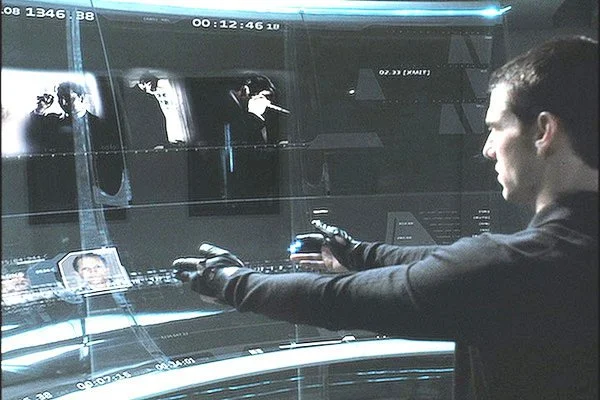
The more we become connected, the more any sense of personal privacy completely evaporates. So goes Steven Spielberg’s vision for our near future, couched in tech noir, mostly because the veil of safety and security has for decades become irrevocably ripped from society. What we see (and everything we don’t) becomes the stuff of life and death in this shadowed thriller based on (another!) Philip K. Dick story, about a pre-crime cop John Anderton (Tom Cruise) whose loyalty and dedication to his job can’t save him from bureaucratic forces. The film's central theme is the question of free will versus determinism. It examines whether free will can exist if the future is set and known in advance. Other themes include the role of preventive government in protecting its citizenry, the role of media in a future state where technological advancements make its presence nearly boundless, the potential legality of an infallible prosecutor, and Spielberg's perennial theme of broken families. There were plenty of breathtaking action set pieces— with the metallic tracking spiders ticking and swarming across a decrepit apartment floor to find Anderton submerged in an ice-cold bathtub with his eyes recently switched out via black market surgery as a key one. What impressed us when watching the movie was how much the technology in the 2002 movie foreshadowed what will happen. Like the pinch and zoom visual user interface Anderton was using to identify suspects, electronic tracking of individuals for marketing (or governmental purposes) and even the Lexus electric car. Most impressive is Spielberg’s sophistication, unafraid of the bleak tidings his film prophecies even as it feigns a storybook ending. What were your reactions to the movie?

Leadership in movies ... Apollo 13

Few movies depict crisis leadership as effectively as Apollo 13, Ron Howard's movie of the real-life NASA mission. While the workplace in question may be thousands of miles above the surface of the earth – and the crisis more pressing than most – it emphasizes the need for leaders to work together to find a positive resolution to a difficult problem. The film has particular value for larger businesses, where collaboration between individual departments can be vital for wider success and extols the idea that there is more than one way to lead successfully. In Apollo 13, this refers to the relationship between Tom Hanks' Jim Lovell, the onboard astronaut (literally) putting out fires, Ed Harris' NASA flight administrator, and Gene Kranz, orchestrating the recovery operation from Houston. Throughout, each character leads their individual team effectively, but it is the openness and the democracy of their collaboration that ultimately saves the day. Here’s a demonstration of leadership who will not submit to defeat even when it’s staring at it in the face – and who won’t let his team accept defeat either. That steely attitude will instil belief in everyone around. This show is great in highlighting crisis management, setting expectations, determination, enabling others to act, teamwork and creativity.

Creativity through watching ... Total Recall (1990)

Very loosely based on Philip K. Dick short story “We Can Remember It for You Wholesale”, Total Recall functions as a construct for Paul Verhoeven to take a high-concept premise about memory implants and lost identity and motivational uncertainty and turn it into an Arnold Schwarzenegger schlock-fest. It should be bad, but it’s not. Unlike many of it’s sci-fi action peers, Total Recall never runs out of steam or ideas; it starts with memory implant, then moves to a vividly imagined Mars society with an oppressed mutant population then gives us a secret alien reactor that’s a MacGuffin but also a deus ex machina. The plot’s a mess but so is Arnold. It all works. Verhoeven, in fact, uses Arnold to tell this darkly exuberant story, from the contorted confusion of the set-up right on through to the eye-popping finale. For as many times as Dick has been adapted, this is perhaps where the frenetic energy and imagination of his work made it work so well (Bladerunner is another thing completely!). From a thinking perspective, it was such an engrossing story but importantly made us think about what is real or are we imaging things, which has some similarities with the Matrix storyline. Although the 2012 remake was very polished and had better action sequences, the 1990 version is classic with maximum Ahh-nuld. What about your thoughts after watching this? How did you see things differently?

Total Recall 1990

Creativity through watching shows

Creativity can be stimulated through movies and television - any show that is thought provoking and expands your mind will do it! So what shows have made such a profound switch in your minds that your behaviour and worldview changes? Here are some of our favourites that we will be sharing this week and why each of them is so special.

The Matrix

A movie that is very much talked about today due to the recent release of the forth movie, The Matrix Resurrections, the original Matrix opened in 1999 and was considered one of the best sci-fi shows around. It was a time when computer-generated imagery was revolutionizing special effects, video tapes were giving way to DVDs and mobile phones were fast becoming a must-have. The Matrix captured all that. It's a movie everyone remembers -- even if they haven't seen it. Having the coolest action sequences that have never been captured on film, it had jaw dropping visuals that will not look out of place even if you watch it today. The movie brought many new ideas into our vernacular including bullet time, virtual realities, simulation theories and red/blue pill choices. Owing to its success, many similar movies about simulations and virtual reality started coming out from Hollywood which were also good (for example Cameron Crowe’s 2001 thriller “Vanilla Sky” with Tom Cruise to Christopher Nolan’s 2010 classic “Inception” to Steven Spielberg’s 2018 adaptation of Ernest Cline’s novel “Ready Player One,” about a near-future in which people leave the trash-filled Earth behind by going into a virtual gaming world) but the Matrix came first and really changed how we perceive technology and humanity.

The matrix has you …


Creativity with Board Games

Of course some of the best tools to inspire and develop a strong sense of creativity is through playing games. At ThinkLab, we have gone through hundreds of playtests and used tens of games to identify some truly useful games that work for our sessions. We do not use educational or learning-type games as their design and development is not based on our strict requirement – which is it must be fun. We sometimes use a word game to stimulate creativity like the ever popular Codenames or we might use an illustrative game like Dixit or the underappreciated Imagine. When using these games, specific words or illustrations can be swopped for gameplay that are meaningful to a company to help make a stronger link with the organization depending on your learning goal.

Many games can be used as long as the person playing the game is able to think differently and open their minds to a new approach so get a great facilitator, keep playing games and constantly try new things to increase creativity at work!

A Codenames session, Dixit cards, Imagine game

Creativity with Legos

Many of us have grown up playing with Legos but probably stop once we hit adulthood. Some may still play with their kids but we want to let you in on a little secret - playing with Legos is a wonderful creativity tool!

We use Legos in many programs and it is a highly versatile tool that can be used not only for creativity, but strategy and communication programs as well. Some may have heard of Lego Serious Play which is a wonderful facilitation method of using the Lego bricks to enhance innovation and business performance.

At ThinkLab, we use our own methodology when utilizing Legos to inspire and foster creativity during our sessions and help our clients make a breakthrough in their thought processes. Try it! Pick up the bricks and see how a couple of minutes or hours with the bricks can help alleviate ideas when stuck in a rut!

Creativity with Minecraft

Another great tool to help improve creativity is Minecraft. Adults will get as much fun and stimulation as children when they play this sandbox game. A sandbox game is where there are no set rules on how a game should be played or a specific set of winning conditions (e.g. most money, greatest area conquered or last man standing). You can be a peaceful farmer or try to fight as many mobs as possible or even end your game by killing the Ender dragon - the choice is yours. With new versions coming out, you will be able to experience and explore this amazing world anew and even learn a thing or two - definitely a great way to boost your innovative juices!

#minecraft #creativity #sandbox #experientiallearning #training #learningisfun

Welcome 2022 - let's be more creative!

Welcome all to 2022! Let’s start afresh with more content for this year and we want to start off with our most popular topic here at ThinkLab – Creativity.

It’s almost impossible to “teach” creativity as it’s about how one thinks, so what we do is to provide activities and games that will lead your neural pathways to connect differently – rewire your thoughts and behaviours. You can try some of these creativity-enhancing activities at home too – attempt more lateral quizzes and puzzles, build a complex Lego structure with your non-dominant hand or simply read a book and understand it by imagining you are someone else (as your parent? Or your child?) to see from a different perspective.

Try something different this year and see how your creativity can improve!

Learning from ... Marvel TV series

As Marvel continues to be in our zeitgeist and has some of the most popular escapist content, they have now  moved from the silver screens to our television screens with 5 great shows. Interesting, many of these shows have surprising twists with a secret villain  - whether it was Sharon Carter, “He Who Remains”, Kingpin or Agatha Harkness – although we can consider Wanda Maximoff a villain owing to what she did in Westview in VandaVision.

Narratively, we find the “What If?” show most compelling as the animated series re-worked stories we were familiar with and reinvented them without having to follow any particular arcs from the Marvel cinematic universe. Creating realistic and relatable characters in these shows also mean that the big bad is not outright evil or power hungry but more of an antihero, a victim to their flawed beliefs. Even though we are suffering a bit of superhero fatigue right now, we are still immensely enjoying the stories and characters the MCU is churning out. Here’s looking towards more great content in 2022!

Learning from ... Wheel of Time

Robert Jordan’s best-selling series of novels, The Wheel of Time is an expansive entry into the fantasy TV genre. While many fantasy series talk about fate, destiny, prophecy, and those are all present in WOT, but few take it quite so literally. The idea of death and rebirth is a constant companion; the story we are watching is just an iteration on a battle that has been fought many, many times before, and will be fought again. Many of the characters we meet are literal reincarnations of heroes and villains who died a millennia ago, and that past, as distant as it is, remains relevant. Sooner or later, it always finds them. As do the monsters.

Although the pacing of the shows feels fast, owing to the books having thousands of characters and backstories, this TV series have to move things along in only 8 episodes to find the Dragon Reborn, the latest incarnation of the one person destined to fight the Dark One and either save or destroy humanity in the process. An interesting twist for season 1 was to keep audiences guessing who the Dragon Reborn is until the penultimate episode but the final “boss fight” seems lackluster - perhaps setting up for more the next session? Going cold into the show is probably best as fans of the book will likely disagree with something, but we had an enjoyable time trying to understand the mythology through the concentrated world-building (the series spans 14 novels).  Ideas of rebirth, choosing the right and wrong paths are key themes this first season and we look forward to following the story to find out what else is in store.

Learning from ... Foundation

This TV series is based on the iconic Isaac Asimov’s Foundation series whose basic setup is that a space-empire in the distant future has ruled the galaxy for many years unchecked, until a smart guy does some space-math and realizes, “Hey, what if space-empire is bad and doomed to fail?”

Unsurprising, the science fiction story has strong themes in class and wealth and how education and status limits people’s lives and their station in life. Long considered an unfilmable show, we came away impressed with how much was brought to life in this 10 episode series although it spans literally thousands of years and multiple jumps in time. The producers had some creative freedom to adapt the sprawling show by creating clones of the ruling monarchy (Brother Dawn, Day and Dusk) to represent the expanse of time throughout the storylines and allowing us to still stick to the plot.

With many sci-fi stories, Foundation also centres on how humans are constantly looking to hope and fighting ceaseless for that hope and survival - good lessons that we can all share. Let’s wish we will be able to see more of the Foundation series in time to come.