
Initially thinking it was about Richard III but turns out a more modern Richard, Richard Williams, who is the father of Venus and Serena the two tennis greats. The themes I felt from his story, how he managed to coach and bring up two top sports personalities (in the movie he claims to have two Michael Jordans) are through determination and clear ambition, sometimes sheltering the kids from tough external prejudices like racism at country clubs and elite academies. He also tried to protect his girls physically from neighborhood gangs in Compton, an impoverished city in Los Angeles. In a way, he had to develop himself, moving away from his own tough childhood shaped by poverty, violence and discrimination growing up a black man in Louisiana. Richard embodies a tireless commitment and somewhat confrontational style to secure a better future for his daughters and the family. The movie provided a wholesome and nice message about hope and “following the plan” with the charismatic Will Smith as Richard who is also nominated as Best Actor.

Learning from the Oscars 2022
The Oscars are only a week away! Which movie do you think will win Best Picture this year? And importantly what can we learn from these movies? We'll do a deeper dive into some of these movies to see what ideas and skills from the movies can be transferred into our learning processes. Here are some of our favourite movies in no particular order:
King Richard: A look at how tennis superstars Venus and Serena Williams became who they are after the coaching from their father Richard Williams.
Dune: Feature adaptation of Frank Herbert's science fiction novel about the son of a noble family entrusted with the protection of the most valuable asset and most vital element in the galaxy.
Don't Look Up: Two low-level astronomers must go on a giant media tour to warn mankind of an approaching comet that will destroy planet Earth.
The Power of the Dog: Charismatic rancher Phil Burbank inspires fear and awe in those around him. When his brother brings home a new wife and her son, Phil torments them until he finds himself exposed to the possibility of love.
#oscars2022 #learning #moviestowatch JJFS ThinkLab

Games that make you smarter and more creative
Good article here about how games can improve cognitive ability and creativity, although I would suggest some are not so effective although popular (e.g. Clue, Chutes and Ladders, Pay Day, Scrabble) while some are relatively challenging unless you are a serious gamer (e.g. Le Havre, Diplomacy, Twilight Imperium, Trajan).

PC games of the 1990s – Romance of the Three Kingdoms II
Romance of the Three Kingdoms II is a turn-based strategy games produced by Koei and based on the historical novel Romance of the Three Kingdoms. Players choose from one of six scenarios that determine the initial layout of power in ancient China. The scenarios loosely depict allegiances and territories controlled by the warlords as according to the novel, although gameplay does not follow events in the novel after the game begins. After choosing the scenario, players determine which warlord(s) they will control. Custom characters may be inserted into territories unoccupied by other forces, as well. A total of 41 different provinces exist, as well as over 200 unique characters. Each character has many statistics, which range from 10 to 100 (the higher the better). A warlord's Intelligence, War Ability and Charm influence how successful he or she will be when performing certain tasks, such as dueling or increasing land value in a province. The player wins the game by conquering all territories in China. This is accomplished by being in control of every province on the map. The game includes a reputation system that affects the rate of officers' loyalties towards their lords, added treasures and special items that can increase an officer's stats and advisers can help their lords predict the chances of success in executing a plan. The game includes statistics galore for those who not only enjoys playing at the micro-level of managing all the individual characters and maximizing their abilities to do actions e.g. recruit other characters or going to war, but also a bigger picture when going to battle with other territories to be the ruler of China.
This is one of my all-time favorite games as it gives me the opportunity to think and plan at both the macro and micro level. It was played during a time when I had a lot of time to experiment and play computer games so I went quite deep into it, even creating spreadsheets to plan different scenarios and to help decide on utilizing which character out of hundreds to choose from. The game does take quite a while with 41 territories to conquer but the process to winning was simply an engaging process of numbers and planning!

You like numbers in a game … we’ve got numbers!
PC games of the 1990s – Perfect General II
Perfect General II, originally released in 1994, featured air power, tank encounters, infantry battles, in-depth planning requirements, and multiple victory conditions spread across world combat zones in both historical and "what if" battles to offer players a global battlefield for waging world war. Major campaigns and 20 scenarios feature the Battle of the Bulge, Desert Fox, Tobruk, Eclipse of the Rising Sun, and The Kursk Campaign. Each scenario offers an assortment of game options for customization of the turn-based action. Three types of basic games (balanced, attacker, or defender), varied lengths, full or partial kill requirements, sighting style, random hits, visible or hidden mines, environmental effects (variable or pre-set) and friendly city unit repairs are just some of the adjustable parameters. Victory conditions vary, running the gamut from point acquisition to defensive holding actions. Twenty-one types of terrain, varied weather conditions, and multiple units expand the level of detail. When you start the scenario, you have to already plan how to spend your resources wisely, how to equip for the battle ahead, how often do you get reinforcements and where do your enemy place their reinforcements are all questions you have to strategize for.
This was an amazing war game for me – moving from playing Risk to Axis & Allies (a much more realistic and sophisticated board game) to this! Being turn-based also gave the arm-chair general in me plenty of time to plan my moves and think strategically. Remembering that it’s not about what has happened before but rather anticipate and make your own strategic and tactical moves to defeat the AI. Some of the real-world scenarios were very difficult to win, which gave me strong appreciation to the challenges a real world general have to face. An evergreen classic!

It’s not a war game unless it has hexes!
PC games of the 1990s - the golden age
1990s was truly a wonderful time to play computer games as a kid. The games were simple yet engaging, strategic but attractive enough using simple graphic engines and DOS operating system with 5 1/4” or 3 1/2” floppy disks that we have to keep slotting in and rotating for multi-disk games. Below is a video of some of those games. Which are your favorites?
These are some of mine:
Shooter games: This was the golden period where the simulation of 3D games started with Doom, Wolfenstein 3D and ultimately we had a real 3D engine in the game Quake. Other favorites include Half-Life and Doom II.
Real-time strategy games: These games were in its renaissance period with the wonderful Command & Conquer, Warcraft and the granddaddy Starcraft.
Sandbox games: Games with no specific target, open-ended mode was pretty popular with Sid Meier’s Civilization II, SimCity 2000.
Role Playing games: Being able to play a character and grow it’s abilities is attractive and some great ones are Diablo and Ultima.
Action Adventure games: Many games fit into this description where we have many of our favorite Star Wars games including SW: Dark Forces, SW: X Wing and Tomb Raider (remember her?)
Simulation/War games: This is probably our favorite genre for its strategic thinking and stimulating challenge of winning against the PC. They include Panzer General II, The Perfect General II, Romance of the Three Kingdoms II, MechWarrior II and Wing Commander.
Gunship - learning from the 1980s
Gunship depicts one of the Western world's finest attack helicopters of that era: The AH-64A Apache. This simulation recreates the weapons, flight systems, and performance of the real machine. The player controls an arsenal that includes laser-guided Hellfire missiles, a 30mm cannon controlled by helmet gunsights, clusters of bombardment rockets – even air-to-air missiles for duels with enemy helicopters! The game starts with flight training at a base in the United States then escalating challenges and hundreds of missions in any one of four regions of the world. After selecting the region, the pilot is assigned a primary and a secondary mission. These could include objectives as "Destroy enemy headquarters" or "Support friendly troops". The latter would be an easier mission, because the battle would be fought closer to friendly lines.
What was interesting in this game was there is no defined time limit. A player can return to any number of Forward Area Resupply Points to be rearmed, refueled and have damage repaired. Returning to the Home Base will end the mission. Ideally, the pilot completes both missions, knocks out other targets, and makes it back to base within 20 minutes.
In its time, Gunship was considered “the best combat flight simulator ever released for an 8-bit computer!" Praising its graphics, weapons, sound, controls, physics, and documentation, it was THE helicopter simulation nominated by numerous computer gaming magazines. You can learn about approaching the missions with some strategic planning but mostly it was an eye-hand coordination type of game. Importantly, it showed how simulations will play a larger part in our lives especially it comes to gaming due to its complexity and sophistication.
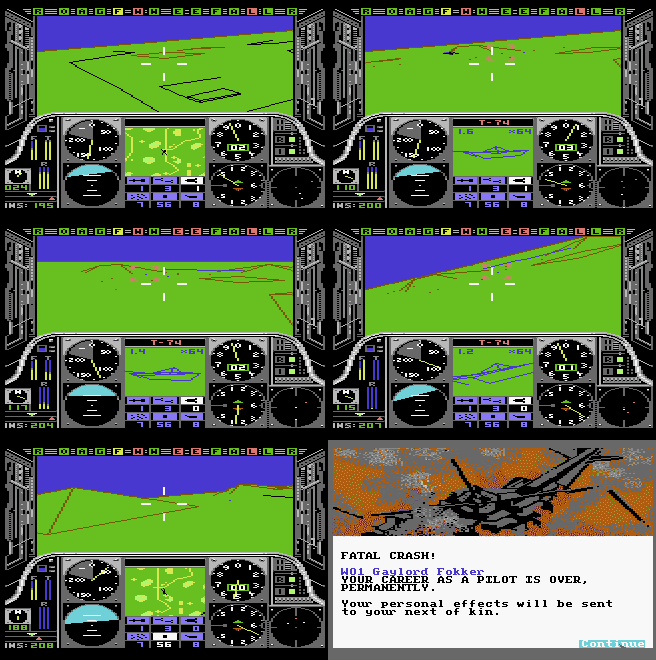
What makes this game truly epic is if you can get a Thrustmaster joystick to play this game!
Nuclear War - learning from the 1980s
Nuclear War is a single player turn-based strategy game. It presents a satirical, cartoonish nuclear battle between five world powers. In the game, you have to blow the four opposing factions to smithereens – sometimes literally through a nuclear strike! You have various options to win, sometimes you can fire a missile or try to lure their population using propaganda. Occasionally a random event occurs, for example aliens would land on one of the factions and the population suddenly grows, or someone throws cows at the opposition, causing a major stampede and killing millions – creating some interesting repercussions to your well-laid plans!
The game is played between five players, four of which are computer controlled and chosen from a selection of 10 satirised “World Leaders” of the past decades (like Ronald Reagan or Mikhail Gorbachev). Each leader is given a country with five different populated cities and once a leader’s five cities are destroyed, he is out of the game. The objective in the game includes building up a decent arsenal, protecting your own cities and destroying the enemy ones by hurling propaganda or flaming nuclear death at them to be the last surviving player at the end.
Please note that we do not condone violence in games or in life. Remember this is a game in the 80s and as a child in those days where you get to have the “power” to make huge decisions like firing a missile is empowering! The game mechanic is interesting as it provides the player the opportunity to make strategic plans slowly due to the turn-based approach and implement, see what happens after. As various outcomes may occur after decisions are made, the game created a very real-world type decision-making matrix to see how to achieve victory. Very entertaining game!

Airborne Ranger - learning from the 1980s
This is an action game which puts the player into the role of a US army ranger. The various missions of the ranger includes destroying a bunker, discovering a missile site or even rescuing prisoners – which led to some nice diversity in this simple mouse clicking game.
The game starts rather strategically as you will be given a mission briefing and then in command of a plane flying over the mission area. You will then drop ammo crates over this enemy area before parachuting down. The mission will then play out on how well you plan your route to overcome the enemy territory (including soldiers, mines, bunkers and foxholes) while picking up fresh supplies of ammunition from the crates and achieving your stated mission.
So this wasn’t just a point and shoot game as there are additional elements of strategic and tactical planning. With the variations of missions, environments and enemies, the way to win is not always straightforward which makes it a nice puzzle in some missions. This will be a great game to reminisce how some games are still able to retain excitement and fun in a relatively simple game format. We recommend!

Check out the map and the third person view of the game.
Loderunner - learning from the 1980s
Loderunner is still one of my favorite games today. I play it occasionally on my phone but the classic version does look dated compared to some updated or similar puzzle chase game you can find in app stores or on Steam. I enjoy it for the puzzle elements, particularly how to collect the treasures buried in the ground with no visible means to retrieve it. Once I was able to break level 100, I realised there was so much more to this game because this was one of the first games that had a level editor where you could create your own mad-hatted Loderunner levels to torture your friends!
It was not just a game to me but an interesting puzzle to solve, so logical thinking skills are required to collect all treasures while avoiding the “guards” who are out to catch you,. Knowing how and when to dig is also a crucial element in solving each game level so there is spatial and timing awareness skills required as well. Understanding and planning for the end goal (the portal to take you to the next level) requires some strategic planning and also tactical skills to successfully collect all your treasures on each level. This is one of those games that wasn’t too complicated but yet challenging enough to draw many people in! You can’t do much better gaming wise in 1983!
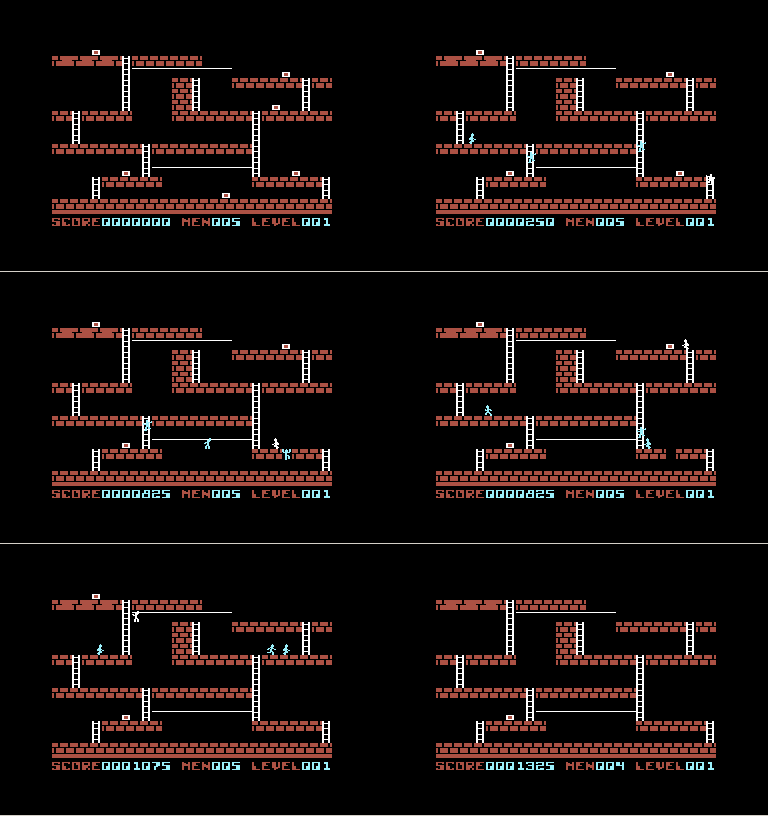
Can you survive level 1?
TGIF - PC games in the 1980s
If you were a kid growing up in the 1980s, you might have played some of these games on the PC. Computers were prohibitive expensive those days but I was able to play with an uncle’s Mac Plus and a friend’s Pre-Pentium DOS PC in those days.
Check out this video if this brings back any memories!
My personal favorites were:
Loderunner - for all the puzzles
Karateka - for the various fighting techniques before Street Fighter
Airborne Ranger - for pretending to be a soldier playing FPS
Operation Wolf - for piloting a helicopter gunship -enough said!
Tetris - for love of polyominos
Nuclear War - because we all want to be a tyrant (some day!) and blow something up
Gunship - cos you can’t have too many helicopter gunships
So which were your favorites? We will discuss how some of these games help in educational and learning ways another time.
Forbidden Island - cooperative game by Matt Leacock
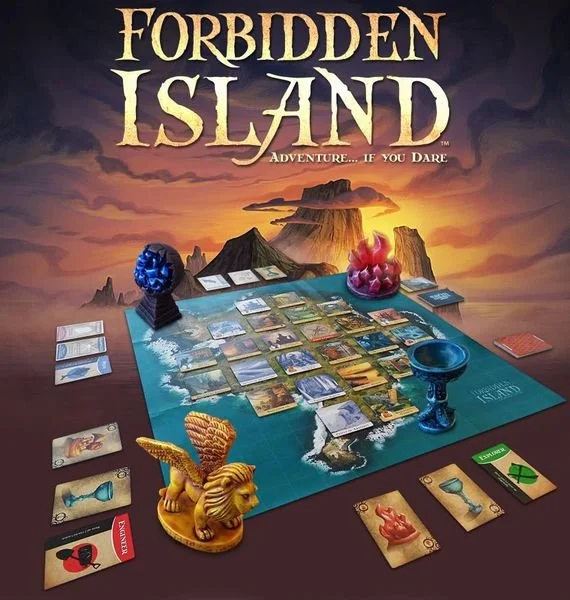
Let’s talk about Matt Leacock’s other popular cooperative game that is not part of the Pandemic series. We have Forbidden Island which is another game that requires all players to work together to defeat the game. Forbidden Island is a visually stunning board game where players take turns moving their pawns around the 'island', which is built by arranging the many beautifully screen-printed tiles before play begins. As the game progresses, more and more island tiles sink, becoming unavailable, and the pace increases. Players use strategies to keep the island from sinking, while trying to collect treasures and items to escape from the island to win.
With multiple levels of difficulty, different characters to choose from (each with a special ability of their own), many optional island formats and game variations available, Forbidden Island has huge replay value. This is a fun game which works for players of almost any age from below teens to working professionals (we have tried!). So if you are game for a shorter cooperative game without too much strategic planning but filled with good tactical experiences and requiring excellent communication skills, Forbidden Island with its beautifully designed game is for you and your team!
Matt Leacock - designer of Pandemic Legacy - game of permanent strategic choices
Matt Leacock is a game designer probably best known for creating the very popular game Pandemic. His most critically acclaimed game is undisputedly the Pandemic Legacy series (particularly Season 1 which was number one on BGG for a long while).
Pandemic Legacy is a co-operative campaign game, with an overarching story-arc played through 12-24 sessions, depending on how well your group does at the game. At the beginning, the game starts very similar to basic Pandemic, in which your team of disease-fighting specialists races against the clock to travel around the world, treating disease hotspots while researching cures for each of four plagues before they get out of hand. During the campaign, new rules and components will be introduced. These will sometimes require you to permanently alter the components of the game; this includes writing on cards, ripping up cards, and placing permanent stickers on components. Your characters can gain new skills, or detrimental effects. A character can even be lost entirely, at which point it's no longer available for play.
So this way of playing games where there are changes to the rules and components of a game is called a legacy system – think of it as a “choose your own adventure” type game where there are permanent repercussions to every single decision the players make when you play a game. So if you want to teach your team about strategic choices and the effects of change, this would be a fantastic game to play.

Matt Leacock - designer of Pandemic, cooperative game
Matt Leacock is a game designer probably best known for creating the very popular game Pandemic. He has been designing games full time since 2014. Prior to that he was a user experience designer at Sococo, Yahoo!, AOL, Netscape, and Apple. Matt specializes in designing family games and have become known for cooperative games since the success of Pandemic and Forbidden Island.
In Pandemic, several virulent diseases have broken out simultaneously all over the world! The players are disease-fighting specialists whose mission is to treat disease hotspots while researching cures for each of four plagues before they get out of hand. The game board depicts several major population centers on Earth. On each turn, a player can use up to four actions to travel between cities, treat infected populaces, discover a cure, or build a research station. Taking a unique role within the team, players must plan their strategy to mesh with their specialists' strengths in order to conquer the diseases. For example, the Operations Expert can build research stations which are needed to find cures for the diseases and which allow for greater mobility between cities; the Scientist needs only four cards of a particular disease to cure it instead of the normal five—but the diseases are spreading quickly and time is running out. If one or more diseases spreads beyond recovery or if too much time elapses, the players all lose. If they cure the four diseases, they all win!
This game was probably the one that introduced the cooperative game where players get to work together rather than compete against each other. Although the theme of this game hits close to home with the covid pandemic, it is exactly this reason why this is such a good game to play to demonstrate the spread of infection and why it takes a strong global response to beat such a major crisis. Due to this game’s success, Matt followed up with more similar Pandemic-themed games that we will be sharing this week.

Economic games – For Sale: learning about Math, Money & Markets (3Ms)
Economic games are about generating income in some way and trying to be the player with the best finances at the end of the game. Economic games usually include some form of market system, which could be straight-up stock trading but could also include trading between players or buying and selling from a central market. Economic games encourage players to manage a system of production, distribution, trade, and/or consumption of goods. The games usually simulate a market in some way.
For Sale is a quick, fun game about buying and selling real estate. During the game's two distinct phases, players first bid for several buildings then, after all buildings have been bought, sell the buildings for the greatest profit possible.
In each round of this first phase, one card per player will be revealed and placed in the center of the table. Players will then have an auction to determine which card will be collected by each player. Players start by placing a bid in coins on the table where others may either raise or pass. Players take properties with lower values depending on how they bid and the winner will take the highest valued property. When all properties have been sold the phase ends. In the second phase, players will try to sell their gained property for money. Like the previous round, one card per player is placed in the center of the table. In this case, instead of using coins, each player now selects one of their property cards and places it facedown in front of them. When all have chosen, they are simultaneously revealed and the highest numbered property card takes the highest valued money card and this continues in order until the lowest property card takes the lowest valued card. Continue this until all the properties have been sold. The player with the highest total wins the game.
For Sale is quick, but yet always filled with tense decision and an occasional brutal resolution in the second phase. In the first phase, you try to get the best cards you can while trying to save your money. With the “must raise” auction, it feels like there is a bit more luck in the bidding phase – sometimes it works out based on where you sit in turn order. In the second half, the game is as much about what cards you have as it is about reading your opponents. Trying to foresee what cards people will play can help you maybe sneak a high money card for a measly small property. It’s like poker in the sense that there’s playing the value of your cards and the player across from you. Great economic and tactical game!
#strategygame #strategicplanning #learnbydoing #economicgame #ExperientialLearning @JJFSThinkLab

Economic games – Century Spice Road learning about Math, Money & Markets (3Ms)
Economic games are about generating income in some way and trying to be the player with the best finances at the end of the game. Economic games usually include some form of market system, which could be straight-up stock trading but could also include trading between players or buying and selling from a central market. Economic games encourage players to manage a system of production, distribution, trade, and/or consumption of goods. The games usually simulate a market in some way.
In Century: Spice Road, players are caravan leaders who travel the famed silk road to deliver spices to the far reaches of the continent for fame and glory. Players are competing to earn victory points by trading in spices (represented by cubes) for Point Cards. The game will end in the round when a player has taken their fifth Point Card, and at that point the player with the highest score will win. The main part of the game is centered around acquiring cubes or converting them using the Merchant Cards.
Century: Spice Road is tense, addictive, and incredibly fun. This is a phenomenal family-weight strategy game which is easy to learn and teach. The theme is not really strong but the gameplay offers interesting decisions from the first turn. You need to build a hand of cards to efficiently acquire, upgrade, and convert spices cubes. So the question becomes which Merchant Cards you need… and at what price. You’ll need cards that work well together, but you also need versatility to adapt as new Point Cards come into the market. Despite that depth and interesting decision space, gameplay is extremely fast-paced around 30-45 minutes. Try it to improve your strategic and tactical planning abilities!

Economic games – Power Grid learning about Math, Money & Markets (3Ms)
Economic games are about generating income in some way and trying to be the player with the best finances at the end of the game. Economic games usually include some form of market system, which could be straight-up stock trading but could also include trading between players or buying and selling from a central market. Economic games encourage players to manage a system of production, distribution, trade, and/or consumption of goods. The games usually simulate a market in some way.
Power Grid is a game with network building and a fluctuating commodities market. The objective of Power Grid is to supply the most cities with power when someone's network gains a predetermined size. In this game, players mark pre-existing routes between cities for connection, and then bid against each other to purchase the power plants that they use to power their cities. However, as plants are purchased, newer, more efficient plants become available, so by merely purchasing, you're potentially allowing others access to superior equipment. Additionally, players must acquire the raw materials (coal, oil, garbage, and uranium) needed to power said plants, making it a constant struggle to upgrade your plants for maximum efficiency while still retaining enough wealth to quickly expand your network to get the cheapest routes.
This is like a mathematical min-max simulation and by all accounts should be extremely boring! Somehow, the interactivity at the market phase with the strategic planning at the route planning stage makes this a very fun and enjoyable game even for those who dislike math! Try it and see it for yourself, Power Grid is another one of the evergreen modern classic games that is well loved by many!

Economic games – learning about math, money & markets (3Ms)
These games are about generating income in some way and trying to be the player with the best finances at the end of the game. Economic games usually include some form of market system, which could be straight-up stock trading but could also include trading between players or buying and selling from a central market. Economic games encourage players to manage a system of production, distribution, trade and consumption of goods. The games usually simulate a market in some way.
In Catan (formerly The Settlers of Catan), players try to be the dominant force on the island of Catan by building settlements, cities, and roads. On each turn dice are rolled to determine what resources the island produces. Players build by spending resources (sheep, wheat, wood, brick and ore). The island is made up of randomly placed hexagonal tiles which makes every game different unlike a printed map. A turn consists of playing a development card, rolling the dice, collecting resource cards based on the roll and position of houses, turning in resource cards. If a 7 is rolled, the active player moves the robber to a new tile and steals resource cards from other players who have built structures adjacent to that tile. Points are accumulated by building settlements and cities, having the longest road and the largest army (from development cards), and gathering certain development cards that simply award victory points. When a player has gathered 10 points, he announces his total and claims the win.
Catan has won multiple awards and is one of the most popular games in recent history due to its amazing ability to appeal to experienced gamers as well as those new to the hobby. It is considered a modern classic and has singlehandedly brought many people into the board game industry. So if you want to teach your child or staff how to strategize resource management and have fun learning abstract concepts, Catan is a great choice!

Are you able to rule the island of Catan?
TGIF - learning about climate change with Minecraft
It’s Friday again, so let’s look at what’s interesting around the world. From C/net, we see that Australia is teaching children about climate change, like forest fires and erosion ,through the use of Minecraft. The Australian Department of Education has given schools free access to Minecraft to create curriculum to teach these topics to great effect. The programs also allowed the kids to create and build solutions to geographical issues like erosion, pollution, urban planning and more. An Australian insurance company also launched a Minecraft mod game called Climate Warriors, a free interactive game designed to teach children as young as 7 how to protect themselves and their homes from bushfires.
We at ThinkLab laud these great efforts to gamify learning but we ask why should children have all the fun? We can also use Minecraft to learn new ideas and concepts for adults and be more open to using games and gamified techniques which have already proven to be not only engaging to all age groups but also helps learners in internalising the concepts and learning from them.
https://www.cnet.com/news/features/how-minecraft-is-teaching-kids-to-face-the-threat-of-climate-change

Days of Wonder game of city building and strategy – Quadropolis
Each player builds their own metropolis in Quadropolis but they're competing with one another for the shops, parks, public services and other structures to be placed in them.
In each round, players first lay out tiles for the appropriate round at random on a 5x5 grid. Each player has four architects and on a turn, a player places an architect next to a row or column in the grid, claims the tile that's as far in as the number of the architect placed, places that tile in the appropriately numbered row or column on the player's 4x4 city board, then claims any resources associated with the tile. After four rounds, the game ends. Players can move the inhabitants and energy among their tiles at any point during the game to see how to maximize their score. At game end, they then score for each of the six types of buildings depending on how well they build their city.
Quadropolis is easy to learn, yet it offers interesting choices, and a good strategy is necessary to win. The innovative mechanics combine with a fun theme to create a high-quality, family-friendly game. There are numerous paths to victory, and different players do well with a variety of city designs. The building types seem well-balanced, with players win with an emphasis on public service buildings to an interlacing of parks and tower blocks. So if you want to hone your strategic planning skills or improve your inner architect abilities, this is the game for you!

Build your own city with Quadropolis!